
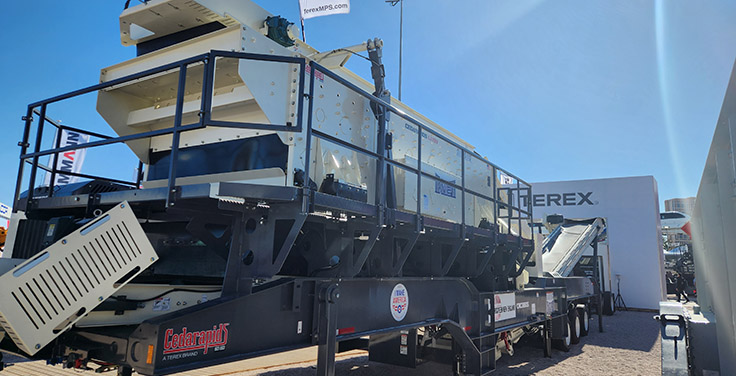

Yanik: Do you get a sense through your ConExpo conversations about crushing and screening equipment that customers are ready to buy if equipment was available today?
Burns: This is my sixth or seventh ConExpo. Every ConExpo, you’ll get people who are pretty excited to see what you have out there. But I can’t tell you how many folks during the first few days of this ConExpo asked me: ‘Can I take this unit home with me today?’ That’s unbelievable. We have this piece (the CRC1350S in the booth) already spoken for. But to hear so many customers request to buy it on the spot shows the demand is out there.
Yanik: Have you ever seen that kind of demand at a prior show?
Burns: A little bit. But comparing how many people said that to us in previous years, it’s not even comparable. It speaks to the fact that [the CRC1350S] is a new plant, nobody has seen this before, everybody sees the value, and producers are trying to do more with less. They’re running fewer people and trying to get more production in less time.
Yanik: Is it comforting for a manufacturer, in some ways, knowing many customers are willing to wait longer for equipment? It seems the customer was reconditioned through the COVID years.
Burns: There’s always some good stability when you have a backlog that stretches like most everybody’s does now. It gives you a better idea how to forecast. It gives you the ability to focus on the parts you need compared to a year when a backlog isn’t as high.
When we’ve got a full backlog, we can focus on the components and really push suppliers to meet the demands that we have. So, all that’s good.
But also, when you’re out this long, you realize customers need plants – and there are not enough plants in the market right now. So, you’re battling that lead-time scenario. That’s the challenge. You always want to be as responsive as you can to the customer, but the lead times are long. It makes it a challenge and creates pent-up demand.
Yanik: We were at the Terex Corp. press conference the other day, with the company identifying market trends. Company leaders identified electrification as one such trend. Do you hear customers in the Terex MPS universe wanting electric equipment? Where are we right now when it comes to electric and the world P&Q readers are living in?
Burns: We’ve been good at electrical plants for a while now. There’s a transition going on with customers trying to get away from heavy maintenance products. You can have multiple generators, multiple engines and hydraulic packages to keep up with.
When you go to an electric-style plant, it’s less maintenance. It’s easier to maintain and with common components in many cases. There’s a skillset that comes along with the work on hydraulics and engines that is getting harder to find, as well.
Simple electronics and simple pushbutton start and stops make operating convenient. We’re seeing that switch from highly customizable plants, or self-generated plants, to more [electric] plants for cost savings – less fuel, less maintenance.