

Yanik: Digitization is another trend Terex identified during its ConExpo-Con/Agg press conference. What are you hearing from customers about their desire to digitize crushing and screening plants?
Burns: I think that will be the future for a lot of plants – to be able to predict liner changes, operational times and tonnages, for instance, or when bearings may be heating up or going bad. Those are vital pieces of information that help keep customers on target. Those features make it handy for somebody to be able to operate a plant, or be a little bit more precise on when they need to change something – or when there’s a red flag.
I think the industry will move more in that direction in the next couple of years. It just makes sense for folks to be able to monitor equipment as telematics and other capabilities come around.

Yanik: Getting back to equipment in the Terex MPS booth, the company has a new screen at ConExpo-Con/Agg. What can you tell us about it?
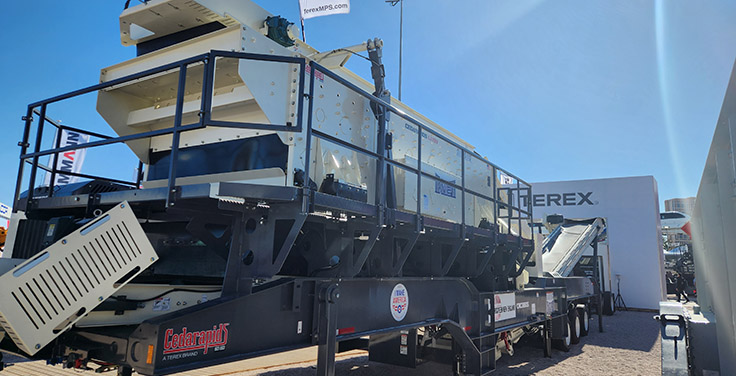
Burns: This is another new-to-market product. This is a Simplicity triple-shaft screen. It’s what we call the ESX. What makes this different from the traditional triple-shaft screen is we extended the clearance between the decks.
The most common complaint with these types of units is the spacing between the decks is often extremely tight. Operators are always looking for that skinny guy. Sometimes, they’re removing the top-deck media to get to the second deck.
Now, we’ve got an enormous amount of clearance between the top and the middle deck – roughly 23 in. – and 27 in. between the middle and the bottom. So, it gives you much more space for maintenance. It’s easier to get in there to look at the performance of the media that you have in.
[The ESX] is going to be geared more toward static-type applications where people really liked the horizontal unit but prefer to go incline in many cases, just because the space between [decks of] an incline is greater. So, we’ve taken that feature from an incline and designed into a triple-shaft.
Yanik: Is the trend right now portable or stationary equipment?
Burns: I think there’s still a little bit of both. We’ve seen more folks considering the portable piece, but there are a lot of known quarries and pits that are going to be operating for a long time. They still have many years of service ahead of them. Maybe they’re getting to a point where they’ve got to update their equipment or they’re looking at increasing production. There are plenty of options to go either way. So the ability to meet your needs is the driving factor.
Yanik: Do you have a sense of the number of portable crushing and screening equipment manufacturers in the market these days? Do you see that number growing?
Burns: There are more players in the industry. Customers are trying to add production, and contract crushers are looking to get into the game. Certainly, there has been a high level of demand – especially in the last couple of years, as the demand for plants and static components has been high. That seems like a good space to be in.