
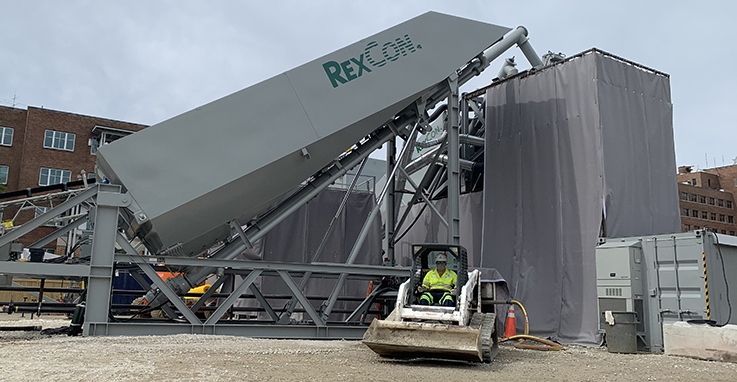


When operating in a compact footprint in a dense urban area, portability and accessibility are necessities.
Therefore, Aggregate Industries, a member of LafargeHolcim’s U.S. operations, installed a portable ready-mix plant to supply concrete for the expansion of MedStar Georgetown University Hospital in Washington, D.C.
The 477,000-sq.-ft. expansion will include a new emergency room, 32 operating rooms, 156 patient rooms, surgical prep and recovery bays, underground parking and a rooftop helipad.
According to Jay Moreau, CEO of U.S. aggregate and construction materials at LafargeHolcim, the company’s involvement in the Georgetown University Hospital expansion is a strategic decision for the company.
“If you think about a project of this size, you’re talking about a 500,000-sq.-ft. facility in the middle of Georgetown,” Moreau says. “There are lots of challenges around that. So what we wanted to do was leverage [our] abilities to provide a solution that was innovative, new and – in this case – portable.”
Advantages of portability
Given the area LafargeHolcim is operating in, the portable ready-mix plant was essential to the success of the project, which batched its first concrete this spring and is expected to be completed in third quarter 2021.
“The biggest challenge is that the footprint is incredibly small,” Moreau says. “I think one of the beauties of a portable plant is that it can fit on a very small piece of property, and then we have to work the logistics to supply the plant so we can do that optimally and do it at the right time of day as we respond to the level of demand by the project.”

Among the equipment at the Georgetown site is a portable RexCon dry batch plant that has a capacity of 170 to 180 yd. per hour, according to Moreau, as well as a John Deere 944L loader to charge the plant. In addition, two to four trucks are used on site, depending on the level of demand on a given day.
One advantage of installing the portable, flexible and self-contained ready-mix plant is that LafargeHolcim is able to meet environmental regulations while also adhering to tight schedules. The plant, which doesn’t require a crane to move, provides concrete to the Georgetown project while reducing traffic congestion in the area.
“This isn’t the typical portable project,” Moreau says. “We designed this plant to fit into what was available. So we talk about the small footprint, but this is a fully-enclosed plant. It’s very efficient [and] there’s no dust discharge.”
Another benefit of the portable ready-mix plant is that LafargeHolcim can be responsive from both a quality control and mix design perspective. According to LafargeHolcim, the portable ready-mix plant allows for faster pours, more accurate batching and on-site testing – all of which improve efficiency and quality control.
“We’re not 10 or 15 miles away where we have lead times and scheduling issues; we’re right there,” Moreau says. “So adjusting it is so much more customer friendly.”
Another common concern for producers is the permitting challenges that operations so often face. Fortunately, the use of portable equipment helps alleviate some of those issues.
“I think that’s a key component of going portable: It’s temporary,” Moreau says. “Permitting is always a challenge, but we feel that we earn our right to operate in any community on a daily basis.”
Part of earning that trust is just simple, straightforward conversations with those in the community. Fortunately, the use of portable equipment allows LafargeHolcim to give definitive answers about the MedStar Georgetown University Hospital expansion.
“We can talk to the neighbors, we can tell them what we’re going to do, we can tell them what to expect and we can tell them when we’re going to be gone,” Moreau says. “So I think it’s a winning equation when you look at it from that perspective.”
Partnering for success

To complete the project, LafargeHolcim is partnering with Bethesda, Maryland-based Clark Construction Group. According to Moreau, the two companies have a longstanding relationship dating back years.
“We’ve been doing business with Clark [Construction Group] for many, many years,” Moreau says. “We started discussions over two years ago to figure out how we could help Clark develop a competitive advantage on the project, and how we can come up with a solution to help them be successful.”
Part of any successful partnership is having similar, if not identical, goals in mind. That philosophical synchronization between LafargeHolcim and Clark Construction was crucial to both companies solving the logistical challenges of this project.
“A place like Georgetown has really unique challenges in that you’re in a very highly-populated area [with] a very small footprint, and you really have to be conscious of how you impact the neighbors,” Moreau says. “That’s what was important to Clark, and that’s what was important to us – that the portable strategy had much more benefit to getting into the community and the neighborhood as much as it was about servicing the requirements of the project.”
Aside from solving logistical challenges, the two companies also teamed up to achieve a goal that every operation strives for: to work as efficiently as possible.
“It’s a situation where we can brainstorm together to come up with ways to save money,” Moreau says. “You have the price of concrete and you have productivity, but there are 50 different small items that you have to address that go into those things. If you work together to make sure you optimize those things, it’s much more powerful than just a price or productivity rate.”
Early on in the project, stay-at-home orders due to the coronavirus equated to lower traffic on the road, which was a temporary – but welcomed – benefit for LafargeHolcim.
“Lower traffic has allowed us to find some efficiency in our deliveries and cut down on delivery time,” Moreau says. “That’s a temporary impact on business, but it’s a nice upside to reduce traffic and be able to get more efficiency out of our equipment.”