
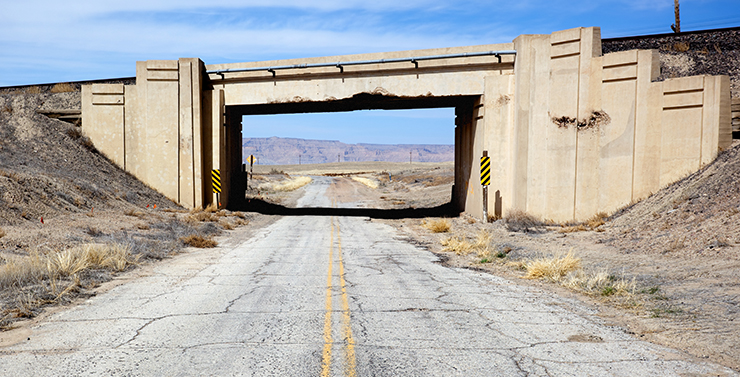


When assessing the state of infrastructure in the U.S., there is one immediate takeway: action must be taken.
Before any roads or bridges can be repaired or rebuilt, though, there must be financial investment from the federal level – something Congress has failed to pass and provide in recent years.
In turn, the lack of federal investment resulted in U.S. infrastructure receiving a D+ grade from the American Society of Civil Engineers in its 2017 Infrastructure Report Card – the same grade it received in 2013. And in the absence of renewed federal funding, it’s difficult to imagine that D+ grade improving any time soon – unless Congress acts.
Pandemic pinch
Despite both economic- and pandemic-related challenges throughout the year, the infrastructure market and construction industry as a whole has persevered.
“The value of work – especially for highway and pavement work – has actually been very strong through the year,” says Alison Black, chief economist at the American Road & Transportation Builders Association (ARTBA). “We’re on pace, if things continue, to actually have a very strong year in 2020.”
While strong backlogs coming into the year provided contractors “record levels” of work throughout the summer, Black says, there are concerns about the road ahead. State and local governments are in a financial pinch as gas taxes and other sources of revenue dried up due to pandemic-related shutdowns throughout the year.
“There’s a lot of stress on state and local governments right now,” Black says. “Where we’ve started to see a bit of a pause is with contract awards beginning in July, which, for most states, is the beginning of their new fiscal year. So work continued [and] the pipeline stayed very steady, but as states have grappled with lower revenue projections, they are making the decisions about their capital programs for the next year, and we’re going to see some pullback.”
For example, Black notes that Michigan will cover some of its revenue shortfall with $3.5 billion in bonds – $300 million of which has already been issued. North Carolina, on the other hand, is one of the states hit hardest by the revenue shortfall.
“They’re scaling back to, I think, 50 projects next year,” Black says of North Carolina. “They’re delaying a lot of work. That’s where you’re going to see that mix of how states address these issues.”
States across the U.S. have delayed or canceled more than $8 billion in surface transportation projects and are in need of more than $37 billion through 2024 to offset revenue losses, according to ARTBA and the American Association of State Highway & Transportation Officials (AASHTO).
Black notes that while AASHTO did revise that $37 billion from $50 billion earlier this year, it’s still a considerable gap.
“When you think about this economic situation and this pandemic, it has really hit transportation revenues in a way that is very different from a more typical recession,” Black says.
In anticipation of financial hardships at state and local governmental levels, Black would like to see Congress and the federal government step up and bridge the funding gap.

“It would be great if there were some sort of help for state DOTs (Departments of Transportation), like we’ve seen for transit and airlines,” Black says. “Helping states backfill that revenue gap would go a long way to ensuring their programs remain whole, both on the operational and the capital side. That’s something Congress could certainly do.”
Pushing for policies
President Trump signed a bill on Oct. 1 extending funding for federal surface transportation programs through Sept. 30, 2021. The FAST Act, which President Obama signed into law in 2015, expired Sept. 30.
By signing the continuing resolution, President Trump and Congress provided fiscal-year 2021 appropriations for infrastructure funding – a needed, albeit temporary, measure.
“One-year status quo provides stability, but it does not provide additional revenue to move the needle,” Black says. “There still is a chance [for more funding]; over the last few years, Congress has added through the appropriations process about $11 or $12 billion on top of the FAST Act funds, so they may decide to do that as they take up appropriations bills before the end of the year.”
In July, the U.S. House of Representatives passed the Moving Forward Act – a $1.5 trillion plan to rebuild American infrastructure – but the bill stalled in the Senate.
So while both parties in Washington have said for years that investment in infrastructure is a necessity – a rare point of agreement for Democrats and Republicans – the old adage says “talk is cheap.”
“We’ve seen this movie before, haven’t we?,” Black says. “People who have been in this industry for a long time know there’s always that danger of people talking about infrastructure, but actually having a political will to get something done has been in short supply the last few years.”
Further complicating the issue of infrastructure funding is a concern that funds have dried up after Congress passed hefty financial stimulus packages earlier this year in response to the pandemic – and is currently working on another stimulus bill.
Still, many in the construction industry view the infrastructure market and the U.S. economy as one in the same – when one is booming, so is the other. Therefore, those pushing for federal infrastructure investment posit that not only would the construction industry see a boom, but so would the U.S. economy as a whole.
“Infrastructure has certainly been part of the conversation in terms of economic recovery, and I think that’s really a key difference from what we saw in 2008,” Black says, comparing 2020’s economic slowdown to the Great Recession. “While the stimulus (FAST Act renewal) provided a modest amount of money for highway and bridge investment, particularly – I think there’s about $27 or $28 billion – it was not a sustained increase in federal investment, in revenue and in the federal program. What we’ve seen historically is that a robust increase in the federal program that is sustained will help move the market.”
Looking ahead
As the construction industry closes the book on 2020, Black is impressed with the industry’s performance in the face of new obstacles and challenges.

“If you look at just the numbers, we have had a strong year,” Black says. “Our industry has shown incredible resiliency [and] the ability to pivot to address the safety issues and keep working amid the uncertainty. That just shows the resiliency and character of our industry and the hard work people have put in.”
Going forward, the continued hope is that 2021 is the year Congress finally enacts sustained investment in America’s infrastructure.
“What we would like to see is a robust increase in federal investment, at the minimum,” Black says. “That would certainly help support market growth over the next five years, no question. What you would see is some states would need to raise their own revenues to match those federal dollars, and hopefully that would provide a path to help the broader economic recovery.”
However, even if an infrastructure bill doesn’t come to fruition in 2021, Black notes that states are in a better position than they were during the Great Recession due to increased and diversified revenues, including gas taxes, motor vehicle registration fees and more. She also says Congress will largely determine how 2021 unfolds for the industry.
“I think we’re going to be in this holding pattern for the next year where you have a mix of what states are doing – pulling back, moving forward – and it’s really going to come down to what Congress is going to decide in the next year and whatever administration is coming in about reauthorizing the FAST Act,” Black says. “If you get a substantial increase in federal investment, that will help drive the market and spur real growth. If you don’t, then I think we’re going to continue to see states grappling with the economic situation the best way they can.”