
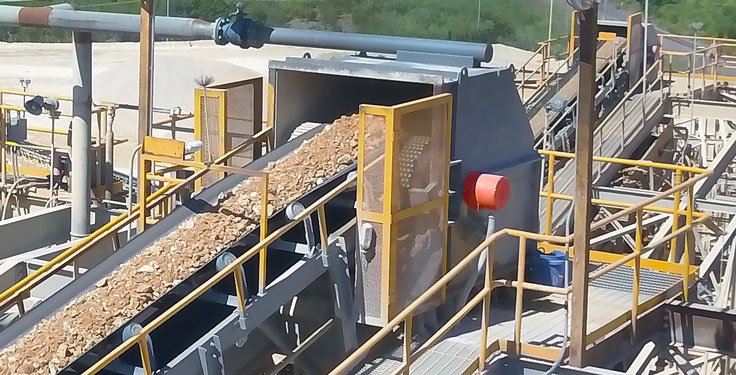


In the harsh and demanding conditions of a mine or open-pit quarry, conveyor drives are susceptible to failure – whether material is being transferred on stationary conveyors or on conveyors fixed on portable plants.
Failure of components such as the electric motor, gearbox, pillow block bearings and other parts, of course, can lead to costly operational shutdowns.
Conveyor components and drives are not immune to the dusty, abrasive conditions found in mines and pits. Electric motor failure is a primary cause of breakdowns in these applications.
Inconsistent loads on a conveyor can easily overload an electric motor, leading to an electric motor failure. Additionally, conventional external conveyor drives often need to be mounted on a special platform beside the conveyor, causing side load. The output shaft from the gear reducer must align with the main head drive roller, which is mounted on the conveyor frame and supported by pillow block bearings.
The performance of pillow block bearings depends heavily on how well they are maintained. Regular checks with a vibration analyzer are necessary to assess the remaining service lifetime before failure. Additionally, these bearings must be greased periodically.
Another area of concern is the rubber lagging on the head roller. Delamination or damage to the lagging from aggregate debris can lead to operational shutdowns and production interruptions.
To prevent throughput interruption, a comprehensive maintenance plan must be established and implemented. The plan should not only address mechanical failures, but also ensure proper belt tension and tracking. Implementing such a plan requires significant manpower and can be costly, especially with a shortage of maintenance personnel in the industry.
A solution to mitigate the maintenance issues associated with conventional multi-component external conveyor drives is to drive a conveyor with a one-component conveyor belt drive such as a drum motor. A drum motor’s drive components, including the electric motor, gear reducer and bearings, are enclosed inside the drive drum, where they’re protected from the environment.
Solution through design

The VDG drum motor is a solution that presents advantages when driving a belt conveyor – including increased electrical and mechanical energy efficiency, reduced mechanical losses, the elimination of side overhang load, and no requirement to lubricate or grease bearings.
Additionally, because the drum motor is powered internally, there is no need for external chains and sprockets to drive the head drum.
In this case, the drum motor has the electric motor mechanically connected in line with the gear reducer inside the drive drum. Because the torque transfer from the electric motor is not through a 90-degree gear reducer, the drum motor is 96 percent mechanically efficient, thereby reducing energy consumption.
In VDG’s experience, an average energy savings of 25 to 30 percent can be achieved depending on the gear reducer design in the drum motor. The company’s electric motor is designed and manufactured to inverter-duty standards. All electric motor windings are processed and VPI-encapsulated for a longer motor life and vibration resistance.
Experience also shows that maintaining a maximum operational temperature of 194 degrees (90 degrees Celsius) or below inside the drum motor is essential to maintain performance and reliability. Temperatures exceeding 194 degrees will reduce the oil viscosity to the point where it no longer functions as a lubricant. Unlike the standard electric motor, which has a cooling fan, the drum motor relies on the oil inside the drum to dissipate heat.
In VDG’s case, motor windings are designed with lower magnetic and current densities to run cooler and preserve oil viscosity for effective lubrication. All of the company’s drum motors 75 hp to 500 hp are equipped with an external oil cooling/conditioning unit. The oil cooler unit extracts the oil from inside the drum motor, filters it, cools it and then pumps it back inside the drum motor, providing 80,000 hours of continuous maintenance-free operation.
Conveyors used in aggregate applications – including portable plants – are often designed to operate at an incline position. Occasionally, it may be necessary to stop and restart a conveyor while it is fully loaded. VDG electric motors, for instance, are built to design “C” standards with a 230 percent starting torque, and they can start with a fully loaded conveyor.
The gears in the gear reducer are manufactured to the AGMA quality 6 standard for minimal backlash, improved gear engagement, low noise and higher service life. The drum motor shafts do not rotate and are fixed with mounting brackets to the conveyor frame, eliminating the need for maintenance or lubrication of external bearings. All drum motor bearings are bathed in oil for optimal operation.
Rubber lagging

Consider, too, that rubber lagging on the head pulley is essential to generate the pulling force required to move the load.
Without rubber lagging, belt slip would occur and result in a reduction in belt pull. Rubber lagging is typically bonded to the drum using either a cold or hot vulcanization method. But, in both cases, the vulcanization adhesive material will not reliably withstand the shear forces caused by a load on a conveyor belt.
VDG developed a lagging system to address this issue. The IronGrip lagging system consists of metal bars welded longitudinally on the drive drum with hot-bond vulcanized rubber lagging sections between the bars. IronGrip lagging eliminates lagging delamination, uneven lagging wear and a longer service life compared to standard lagging.
Additionally, VDG has found that a drum motor with IronGrip lagging improves belt tracking, increases the pulling force by 40 percent, and reduces a system’s bearing and idler load.
Final thoughts
Many operators have found that conventional conveyor drives operating in harsh and demanding conditions present increasing costs due to maintenance, wear parts and motor reliability. The drum motor design advantages discussed in this article, however, can eliminate external component servicing and common lagging issues that drive up maintenance costs, manhours and production interruptions.
Alex Kanaris is president of VDG (Van der Graaf).