

Crushing, screening and blending help adjust construction material gradations, though the material may still require washing to meet cleanliness specifications.
There is more to water’s role in processing than just washing. Other functions include clay and silt removal; removing shale, coal, soft stone, roots, twigs and trash; sizing; classifying and separating; and dewatering.
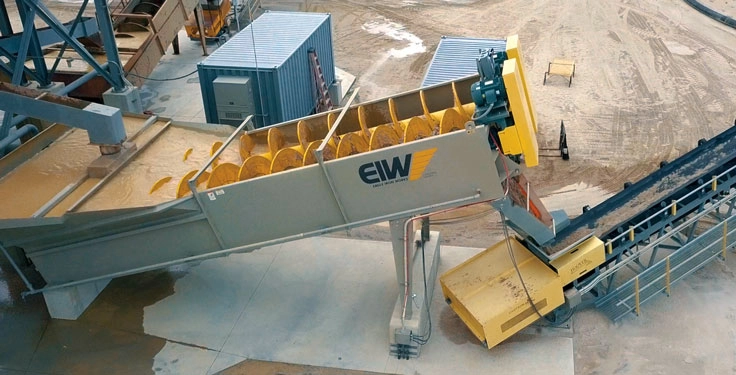
Processing material for various market applications often involves different combinations of equipment. In portable applications, among the most commonly used washing and classifying equipment include fine material screw washers, hydrocyclones and classifying tanks.
Keeping these pieces of equipment maintained is crucial to maximizing production, efficiency and profits.
Fine material screw washers
Because fine screws are often mounted on a shared portable chassis with the screen, unexpected downtime can sideline the whole portable spread.
To maximize performance with a fine material screw washer, consider the following:
■ Adjust screw speed for finer sands. Screw speed is determined by the percent passing 50 mesh. Finer material requires more time to settle in the washer tub, so slower speeds are necessary. Screw speed can be calculated by dividing 1,500 by the percent passing 50 mesh.
For example, if 15 percent of the material passes 50 mesh, the screw should operate at 100 percent speed. If 20 or 30 percent passes 50 mesh, the screw should run slower at 75 or 50 percent speed, respectively.
Excessive shaft speed can cause fine material to accumulate in the washer tub corners, eventually filling the pool area and causing product-sized fines to overflow into the waste.
■ Add processing steps when needed. Additional washing may be required when sand feed contains high amounts of minus 200 mesh (0.075-mm) material. Generally, when minus 200 mesh exceeds 12 to 15 percent, a two-step process should be considered. This can be achieved with two screws or a hydrocyclone feeding a screw.
■ Ensure sufficient water supply. Adequate water is essential for washing aggregates. As a rule of thumb, fine-material washers require 50 gallons per minute of water per ton per hour of silt removed.
■ Incorporate rising current. Rising current allows fine-tuning via water injection beneath the pool areas. The addition of clean water improves classification by keeping ultra-fines in suspension while product-sized particles settle out.
■ Level the weirs. Proper weir adjustment fine-tunes washer performance and improves the removal of fines. To remove small amounts of excess fines, raise the side weirs and lower the back weir. This increases velocity over the back, carrying excess minus 200 mesh fines out of the washer.
■ Use flush water to reduce buildup. Adding water to the dry deck area can result in drier sand discharging to the conveyor and product pile. Flush water clears fine sand accumulation, maintaining open channels for drainage.
■ Maintain proper feed entry. A calm pool area maximizes fines retention. Excess turbulence in the washer tub can cause the loss of minus 200 mesh fines and some plus 200 mesh fines. A feed chute or flume with a velocity break box helps minimize turbulence.
■ Lubricate equipment properly. Proper bearing lubrication is critical for reliable operation and reduced downtime. For a 40-hour-per-week operation, lubricate the rear outboard bearing every three months or 500 operating hours. Avoid over greasing, as this can damage seals and plug the drainage port.
Hydrocyclones
Compact cyclone packages are especially attractive on portable and modular platforms where footprint and setup time matter.
Cyclone performance is influenced by six key factors:
1. Size. Hydrocyclone size plays a major role in performance. Each particle migrates to a position where centrifugal force equals drag force. If centrifugal force is greater, the particle exits through the underflow; if drag is greater, it exits through the overflow. This balance point is known as the D50 or cut point. Smaller cyclones generate stronger centrifugal forces, producing finer cuts. Larger cyclones generate weaker forces, producing coarser cuts. For primary sand production and desliming, larger cyclones are recommended, while fines recovery typically employs smaller or multiple cyclones.
2. Flow rate. Flow rate affects the internal pressure of the cyclone. Lower feed pressure produces a coarser cut, while higher feed pressure produces finer separation. Pressure can be adjusted by changing pump speed. Slowing the pump decreases flow and pressure, resulting in a coarser cut, while increasing speed increases both, resulting in a finer cut.
3. Inlet area. The inlet size determines capacity. Larger inlets allow higher throughput at the same pressure. Adjusting inlet area can increase or decrease capacity without altering pressure.
4. Vortex finder diameter. The vortex finder extends into the feed box and controls separation. A larger diameter allows more material into the overflow, resulting in a coarser cut, while a smaller diameter produces finer separation. Larger vortex areas reduce internal pressure, sending more material to the overflow. Smaller areas increase pressure, sending more to the underflow.
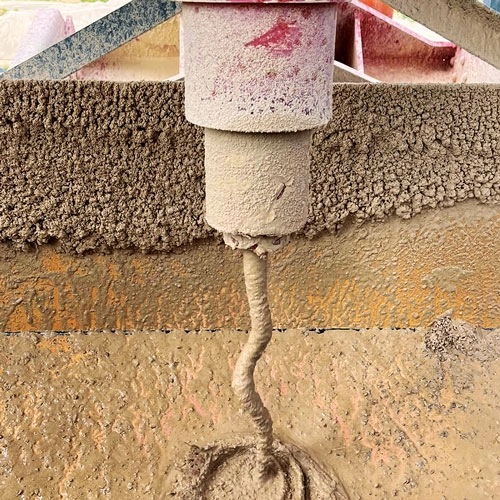
5. Underflow diameter (apex). The apex must be matched to tonnage. If too small, the air core cannot form properly and the underflow will “rope,” indicating poor operation. If too large, excess air, water and fines pass into the underflow, negatively affecting the cut point. A smaller apex reduces bypass and increases underflow concentration, while a larger apex should be used if coarse particles appear in the overflow or underflow roping occurs.
6. Length. Cyclone length affects separation by determining residence time. Longer cyclones provide more time for particles to separate, producing finer cuts. Shorter cyclones reduce residence time and make coarser cuts. Length is influenced by cone angle and optional feed box extensions. A 10-degree cone angle creates a longer cyclone, while a 40-degree angle produces a shorter one.
Hydrocyclone performance should be evaluated at the feed, overflow and underflow. By comparing results to application goals, operators can adjust size, pressure and components.
Dewatering screens
Alongside stationary and skidded dewatering screens, portable units have become commonplace in the industry.
First widely used in dewatering a hydrocyclone underflow where plus 400 mesh solids can be recovered, they have been used for more than 25 years to dewater fine material screw washer discharge that results in a drip-free washed sand.
Using rubber or polyurethane liners and screen media, and, in most designs, dual-enclosed, low-horsepower vibrating motors, dewatering screens provide reduced operating cost per ton of production for many wet processing plants.
Varying dewatering screens are on the market. A properly designed dewatering screen discharges the driest-washed sand product of any commonly used dewatering device. Additionally, less space is required than other options.
Depending on the slurry of the sand feed and the percentage of solids in the sand flow, these units often require a sump, pump and one or two hydrocyclones to partially dewater the slurry and allow the screen to adequately perform. The capital cost of a dewatering screen system is often more than two times other choices, and the electricity cost is often up to three times more.
Information for this article derived from Pit & Quarry University.
Related: Avoiding washing equipment woes