
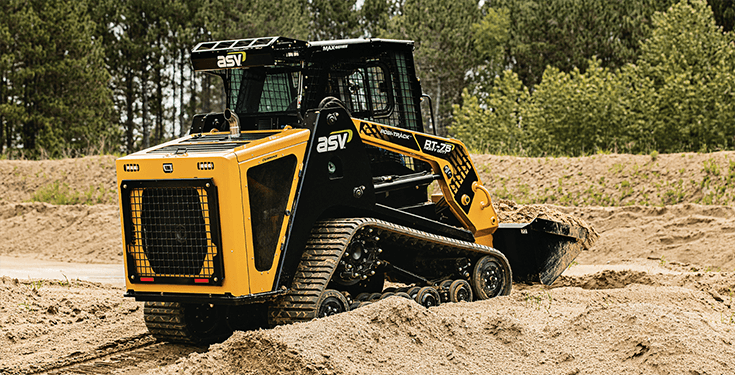


Compact track loaders are an increasingly vital part of contractor businesses.
The sheer versatility of these machines allows them to thrive in a variety of working conditions. Thanks, in part, to growing attachment diversity, compact track loaders can be used for more applications than ever.
A strategic purchase of a compact track loader can transform productivity, providing the opportunity to take on more jobs – and often in new applications. The profitability of a compact track loader for a contractor’s business, however, can vary greatly from machine to machine. Factors such as repair costs, maintenance intervals, fuel efficiency and resale value affect what the loader will cost an owner in its lifetime.
Thankfully, there are indicators contractors can look for to help determine which will be the most profitable machine to invest in and, ultimately, offer the lowest total cost of ownership.
Purchase price
While it can be tempting to favor the cheapest possible option, contractors should consider a few things to ensure their initial investment doesn’t end up costing them more in the long run.
First, contractors should be sure to invest in a compact track loader that will handle the jobs they plan to use it for. This means considering horsepower, lift capacity, ground speed and attachment capabilities.
Contractors must also consider seasonal weather conditions – snow, rain, heat, cold – that could challenge their compact track loader beyond its capabilities. Putting stress on a compact track loader that it was not designed for will inevitably increase maintenance and repair costs over time, as well as reduce efficiency due to more frequent breakdowns.
Additionally, contractors should account for other factors that play into total cost of ownership to ensure their compact track loader will be cost efficient to own. Other factors include anticipated maintenance expenses and other operating costs.
Often, investing in a higher-quality machine upfront will save owners money over time. Consider that the difference in price between a high-quality loader and a cheaply manufactured machine is only a fraction of the total cost of ownership over the machine’s lifetime.
Components
Considering that a set of tracks for a midsize compact track loader can cost upwards of $3,500, track life is a major factor in the lifetime cost of a machine.

An internal drive sprocket design can greatly reduce cost of ownership by extending track life. External drive sprockets accelerate tooth wear, creating steel “hooks” over time because the sprocket teeth face resistance as they release from the track. Sprockets in an external drive system can see cracking and internal tooth wear and require replacement in as little as 500 hours.
An internal positive drive does away with this extra friction with a roller sprocket design, which reduces wear and increases the length of track service intervals. Track warranties are a good indicator of expected life, and therefore the costs associated with maintaining the compact track loader’s track system. The longer the warranty, the stronger the manufacturer’s confidence in the life of their tracks.
The sprockets themselves can rack up costs for compact track loader owners, as well. An advantage of an internal drive system is that it has replaceable rollers that allow inexpensive maintenance as the system sees wear. External drive systems use cast sprockets that require replacement as a unit. These cost around $500 per set, making internal drive systems a much more palatable design, especially in the long term. Compact track loader owners can expect to replace sprockets on external drive systems annually, depending on conditions and hours used.
Undercarriage design is another major player in compact track loader total cost of ownership. There are two main design types: open and closed.
Conventional wisdom used to say that closed-tub designs prevented dirt and material from getting in, reducing wear and maintenance costs. But studies have shown the reverse is true.
Open undercarriages tend to see less wear and cost less to maintain than closed-tub designs. Open designs are in a sense self-cleaning. Dirt and debris are able to fall out of the undercarriage, preventing the material from getting stuck in the tub and causing wear in undercarriage components. Closed designs tend to see more wear on seals and wheels due to material falling into the tub but unable to find its way out.
Regular maintenance
Regular maintenance activities such as oil changes, daily and weekly greasing, and changing fuel and hydraulic filters, are often an underestimated factor in total cost of ownership.
Even planned maintenance takes time, and in a contractor’s world, time is money – especially during a busy season.
Designs incorporating easy access to drain and fill plugs provide a key difference in reducing maintenance time. Some designs require track removal for motor oil changes – an inconvenience that can cost contractors hundreds every year in labor costs, not to mention lost work time.
Fuel and hydraulic filter mounting and access can also make a huge difference in the amount of time a compact track loader is down for regular maintenance. Machines designed for simple maintenance will have rigid-mounted, spin-on fuel filters for easy access and faster changes.
Some manufacturers use insert filters that are often hidden deep in the engine bay. While this can save them headaches on the engineering side, it costs the end user time and money.
A compact track loader that features hydraulic filters in easy-to-access places can save operators precious minutes on every filter change and allow them to get back to work faster.
A well-designed machine will also feature vertically mounted filters. Some manufacturers include horizontally mounted filters that create an inevitable mess of spilled oil when they are removed, causing even more wasted time and dragging out the process.
Finally, a well-designed compact track loader will have easily accessible grease points.
Tracking issues
Beyond regular maintenance and wear parts, periodic track derailment is an expensive and all-too-common issue for compact track loader operators.
The main culprit is traditional steel tracks that are rigid and derail relatively easily in rough terrain or side slopes.
In contrast, all-rubber tracks are reinforced with flexible, high-strength internal polycord. This allow the tracks to flex around objects that find their way into the undercarriage and maximize ground contact.
These machines also feature extra track guiding, virtually eliminating track derailment, as well as reducing the number of tension adjustments required as hours are put on the tracks.
Track derailment can waste the better part of an entire workday. Compact track loader owners can expect four to five hours of labor every time a track derails. Factor in some labor and travel, and derailment can cost around $600 per event – plus a lost day of work.
Getting the most out of a machine
Another often-overlooked element of total cost of ownership is equipment utilization and performance.
A compact track loader that can function in a variety of conditions and multiple seasons, for example, increases its value to a contractor’s business.

Year-round utilization has huge implications for the profitability of the machine. Staying busy in winter months with snow removal services can help contractors get more value out of their equipment. While compact track loaders tend to have a reputation for lackluster performance on snow and ice, some manufacturers make compact track loaders that perform as well or better than their wheeled counterparts in snow.
A high number of ground contact points is key for winter work because it increases traction, allowing the machine to push and turn well on snow and ice. It also reduces ground pressure, which increases flotation and decreases the risk of the track loader getting stuck in tricky areas.
Suspension is a major factor in a compact track loader’s productivity. With rigid-mounted designs, machines feel the effect of every bump, causing components to wear faster. Rigid machines have been known to experience cracked frames and hinges, as well as loosened bolts.
A suspended system will save contractors money in the long run by preventing premature wear on components. Suspension can reduce fatigue on the entire machine, including the frame, loader and bolts, and it can make life easier for operators in the process, allowing them to work longer days more comfortably.
Resale value
The final piece to a comprehensive total cost of ownership calculation is expected resale value. A good place to start is researching equipment trading websites or other used equipment listings online to estimate what different machines tend to sell for used.
Assuming the average compact track loader trade-in happens at the three- to four-year mark and track loaders are used, on average, 750 hours per year, the average machine will be at somewhere between 2,250 and 3,000 hours at trade-in.
With these conditions in mind, it will help contractors to know that the average midsize compact track loader will sell for 50 to 60 percent of its retail price at three years old, and between 40 percent and 50 percent at four years old. This figure is certainly not going to hold true in every situation, but it can be a good starting point for the equipment manager searching for a compact track loader investment that will hold its value.
Bringing it all together
Calculating total cost of ownership upfront can help contractors anticipate expenses over the life of a machine.
The contractor who looks at only one or two variables when choosing a compact track loader will almost certainly miss out on making the most effective decision for their business. Taking the time to consider every facet of total cost of ownership – purchase price, maintenance costs, utilization and resale value – will help minimize any unwelcome financial surprises in the life of the machine, as well as set up a contractor’s business for long-term success.