


For Jason Tutterow of Carolina Drilling, every job is a blast.
The second-generation owner and operator leads the Mocksville, North Carolina-based company that specializes in drilling and blasting the region’s often persnickety soil.
“We go from the North Carolina, South Carolina coast all the way west to Nashville, Tennessee, and east to Augusta, Georgia,” Tutterow says. “We specialize in drilling and blasting for water and sewer pipe municipalities. We probably lead the East Coast in that.”
When rocky soil conditions halt even the toughest excavator buckets from digging, that’s when Tutterow’s crews come in. They put holes in the soil with drill rigs, filling them with explosives that break up the rocks, causing a rippling chain of kabooms that creates an earthen wave.
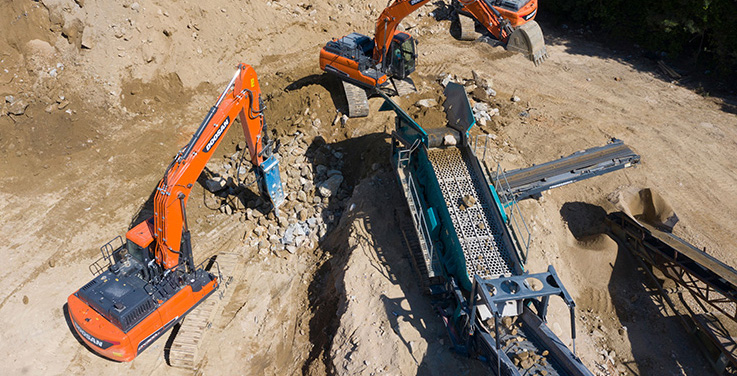
Breakers attached to Doosan excavators help hammer down the resulting stone before Tutterow’s sister business, Reese Crushing, arrives with a parade of more machines ranging from 22 to 35 metric tons in size. Those excavators let crews move the rock into a nearby crusher before the resulting material is reused on site.
Carolina Drilling has its work down to a science, clearing the way for pipe trenches at roadways, high rises and shopping developments across the Southeast. But a recent housing development project just north of Raleigh, North Carolina, proved rather unseemly for Carolina Drilling’s crews – at least at first.
The problem underground
The development in Wake Forest, North Carolina – called Elizabeth Heights – includes about 150 houses and 100-plus duplexes and multifamily homes. It was one of three such jobs Carolina Drilling had in the area, with the company partnering with sister company Reese Crushing to work on the project in tandem.
Starting in the summer of 2019, Tutterow’s teams had to drill and blast to make way for water, sewer and stormwater lines, plus dry utilities for all the homes before using the blasted rock – known as aggregate base course, or ABC – to support paved streets throughout the development. The job required a drill rig, two crushers and a screen onsite along with three excavators – one with a breaker and two with buckets for moving the rubble after a blast. The yearlong project proved big for Tutterow’s businesses, providing about 8 percent of sales for the year.

But the job’s biggest challenge lay waiting beneath the soil.
The rock beneath the 96 acres of former farmland is “very seamy,” Tutterow says, with streaks of rock and soil that allow energy to easily escape from blasts – taking the oomph out of explosives. The soil was exposed to a water source at some point, Tutterow says, leaving the ground to degrade as it froze, thawed and refroze over millennia.
“That happened long before we got here,” Tutterow says. “But it’s no different than getting a pothole in the street.”
Neighborly on the job
Making matters even trickier was what surrounded the jobsite: a bevy of already-occupied homes, providing a less-than-ideal environment for explosives. With two other developments bordering the premises, Carolina Drilling didn’t need any dust-ups beyond the literal ones caused by their blasting.
Carolina Drilling notified neighbors via emails and newspaper ads. Permits for two counties followed, and the fire marshal eventually signed off. Then, Carolina Drilling hired a firm to set up vibration monitors in the area to ease homeowners’ concerns about any rumblings. Photos were taken of all homes within 500 ft. of the blast to document that no cracks formed or expanded after detonation.
The pre-blasting precautions took two weeks. That process wasn’t necessary only a few years ago, Tutterow says, and certainly not when his father, James Tutterow, founded the business in 1981.
“Ten years ago, it was a lot easier,” he says. “You got a blasting permit. We just got there and blasted.”
A seal for every seam
With the neighbors notified, the blasting process could commence. But first: those blasted seams. The stacked layers of rock and dirt didn’t allow the pressure needed for a sufficient blast.
The solution? More firepower.
Tutterow’s team turned to a process called decking, which involves identifying precisely where a seam – or differing layer – occurs within a drilled hole and strategically placing layers of explosives (or “decks”) within the hole so the charges act to seal the seam, preventing the loss of energy during blasting.

Once the seams had been sealed and blasted, another problem arose. The non-ideal soil, once blasted, produced a non-ideal quality of rock – larger chunks that required more work to break down so they would fit into a crusher. That’s when the Doosan machines got to work.
Outfitted with hydraulic breakers, the excavators beat down the boulders until they were around 24 in. or less. A slew of screening and testing followed to ensure the resulting rock was precisely up to state code before being used onsite to help construct the neighborhood’s streets.
“It sounds easy, but you’ve got to have a good driller that can really tell you where that seam is at,” Tutterow says. “If he misses it by a foot and you’re actually putting your deck in the wrong place, it’s just defeating the purpose.”
Fortunately, Carolina Drilling has a slew of good drillers, including veterans like Alvis Bell, Jack Meadows and Jim Satterfield – company employees of nearly 30 years. They just don’t make drillers like they used to, Tutterow says.
“It’s hard to find anybody to do this kind of work anymore,” he adds. “So, a lot of my drillers have been here since the ‘80s and ‘90s. They are very skilled at what they do.”
Information for this article courtesy of Doosan Infracore North America and Two Rivers Marketing.