
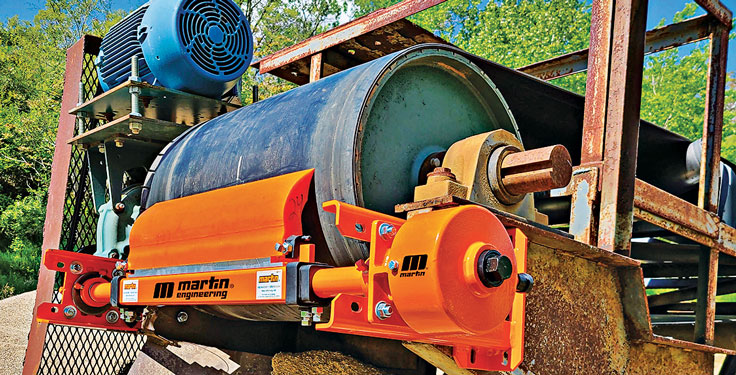


There are many issues to consider when specifying the most appropriate conveyor belt cleaner, not the least of which is maintaining proper tension to achieve optimum cleaning performance without introducing related problems.
Inadequate tensioning causes carryback to cling to the belt and spill along its path, piling up under the conveyor and emitting excessive dust. Managing this requires extra labor for cleanup, and air quality can be affected.
Overtensioning leads to friction damage to the carrying side of the belt, premature blade wear and potential splice damage.
“There are two basic approaches to applying tension to the belt cleaner: linear and rotary,” says Dave Mueller, product manager at Martin Engineering. “The blade’s cleaning position and angle of approach to the belt often dictate whether a linear or rotary tensioner is used.”
The Conveyor Equipment Manufacturers Association (CEMA) defines cleaning positions as primary, secondary or tertiary. Primary cleaners typically function with a “peeling” action, while secondary and tertiary cleaners are typically scrapers.
Belt cleaners mounted in the primary position generally employ a rotary-style tensioner, while most units mounted in the secondary or tertiary positions use linear-style tensioners.
In most cases, belt tensioners must be monitored and adjusted manually so they can maintain optimum pressure and carryback removal. Estimating when blades need to be changed is often a guessing game. If left in place too long, unnecessary complications could surface.
Linear tensioners
According to Mueller, linear tensioners are most often applied where the compensation for wear is required in small increments – such as with hard metal-tipped cleaners located in the secondary cleaning position or with brush cleaners.
The simple design of linear tensioners often allows just one setting for full blade wear. In addition, these tensioners can accommodate actuator deflection for accurate adjustment of cleaning pressure, delivering the ability to accommodate uneven mounting positions or asymmetrical blade wear.
Rotary tensioners
With rotary tensioners, the required tensioning forces can be applied by springs, hydraulic or pneumatic cylinders, electric actuators or from torque stored in an elastomeric element. Rotary tensioners are often used with urethane blades, where the change in blade height and thickness as it wears is significant.
Rotary designs tend to be compact and, in most cases, the actuators can be mounted at any orientation. This provides options for installing belt cleaners in the optimum position.
Air tensioners
Air tensioners use the resilience of a pneumatic cylinder to cushion impact. The tensioners can use an air connection kit to plug them directly into an existing air system, allowing for a more streamlined installation process.
Spring tensioners
Spring tensioners maintain efficient belt cleaning with a rugged coil spring. Some spring tensioners deliver effective cleaning while cushioning splice shock to prevent damage, well suited for tensioning heavy-duty belt cleaners while standing up to tough conditions.
Dual tensioning is recommended for belt cleaners installed on belts wider than 48 in., but dual tensioning does not change the fact that regular adjustment is required to maintain suitable cleaning pressure on the belt.
Final thoughts
While manufacturers continue to improve belt cleaner effectiveness, it is clear there is no single or ideal solution for belt cleaning and tensioner selection.
Safety should always be the primary consideration. Ease of inspection and maintenance is critical for belt cleaner effectiveness, so the tensioner must allow for quick and safe service.
Information for this article courtesy of Martin Engineering.