
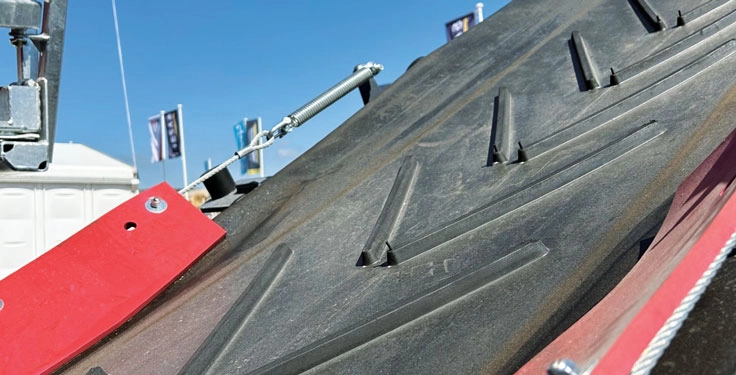

With the potential to move hundreds of tons per hour, it’s safe to say conveyors and their belts are built to withstand relentless impact and force.
Behind the scenes, though, there’s a preventative maintenance schedule powering every high-performance conveyor, keeping on top of issues before they lead to a breakdown.

From carryback material to material spillage, there are plenty of issues to watch for on-site. With regular inspections, timely repairs and good housekeeping, operators can significantly reduce unplanned downtime, extend belt life and improve conveyor safety.
Conveyor belt checks
Once conveyed materials are in motion, the surface of your conveyor belt is subject to unpredictable impact and contact. The effects can differ depending on what materials your conveyor is moving.
Sharp materials like steel rebar increase the likelihood of belt tears and punctures, whereas fines such as sand and silica are highly abrasive. Continuous contact from fines can gradually wear away the belt cover, particularly at loading points and discharge areas. Moist materials are more likely to adhere to the belt after discharge, leading to potential problems such as material buildup, which can quickly become a bigger problem if not addressed early.
When inspecting the belt surface, look out for any signs of adhered material, cuts or tears, gouges, cracking or any signs of delamination. Small cuts that haven’t penetrated the belt carcass can often be repaired using cold repair compounds, hot vulcanized repair patches or rubber repair kits.
Keeping a mechanically fastened replacement belt in stock can significantly reduce downtime in the event of major damage.
Conveyor belt tracking
A well-tracked belt is centered and aligned. It optimizes conveyor performance and helps achieve maximum desired throughput.
Conversely, belt mistracking, where a belt drifts to one side even slightly, can cause spillage, uneven wear and belt damage over time. Addressing the issue as soon as possible helps prevent it from becoming a bigger problem.
Alignment, load distribution, environmental factors and sudden changes such as build-up, seized rollers or impact damage can all affect belt tracking.
Simple checks – where the belt drifts, whether it only misaligns under load and whether issues appear on the carry or return side – help pinpoint the cause.
Addressing carryback material
Some degree of carryback is expected on almost every conveyor, especially when handling fine, wet or sticky materials. Realistically, conveyor maintenance doesn’t eliminate carryback material altogether; it reduces it so it won’t cause operational or maintenance issues.
Keeping carryback material under control starts with belt cleaners. The right combination of belt cleaners includes a primary belt cleaner immediately after discharge, a secondary cleaner to remove finer residual material and, in demanding applications, a tertiary cleaner.
Cleaner blades can gradually wear over time, so inspect them regularly to ensure they maintain consistent contact with the belt surface, are correctly tensioned and aren’t showing signs of excessive wear. Replace the cleaner blades when performance begins to decline.
Look out for material spillage
Like carryback, some material spillage can be expected from a conveyor moving irregularly sized or unstable materials. This is especially noticeable at loading and transfer points, at high belt speeds or with inclined conveying.
However, if material spillage persists, operators can do several things to minimize it.
The first and most obvious thing to consider is whether the conveyor is being overloaded or loaded off-center. Conveyor belts’ carrying capacity is determined primarily by belt width but also by the belt speed.
For instance, a 20-in. belt has a lower carrying capacity than a 48-in. belt. Material characteristics also play a key role, so consider bulk density and lump size. Remember that if material lands on one side of the belt, it will spill over the edge, so check whether the belt is being loaded off-center.
Next, consider skirting and sealing. Conveyor skirting is your first line of defense against material spillage, so ensure your conveyor has skirting rubber fitted and that it hasn’t worn out.
Use the correct skirting and sealing material. Skirting should be a softer shore hardness than the belt to prevent damaging the conveyor belt. Skirting rubber needs to maintain contact with the belt’s surface to stop material from escaping, so, by nature of its position on the conveyor, it will wear over time.
Keep an eye out for worn skirting rubber. Material spillage can affect production, safety and maintenance costs, so it’s worthwhile to replace worn skirting rubber in a timely manner.
Final thoughts
Maintaining a conveyor system means looking ahead. Effective maintenance is about preventing breakdowns, not just reacting to them. Regular inspections of belts, skirting and cleaners help detect wear, misalignment and build-up before they hurt performance.
Pairing quality components with a structured preventive maintenance program maximizes uptime, improves safety and reduces total cost of ownership.
Morgan Walker is vice president at Smiley Monroe.
Related: Prioritizing proactivity and crushing plant maintenance to avoid excessive downtime