


Maintaining a safe work environment on jobsites is critical. There are many areas of an operation that pose safety hazards – inadequate walkways or scaffolding and poor housekeeping, just to name a few.
Another element that should be focused on is mobile equipment operation. Navigating tens – in some cases, hundreds – of thousands of pounds around a jobsite requires the proper safety precautions be taken by the operator ,as well as those in and around the site.
Wear seat belts
Seat belts are an essential safety feature for construction materials jobsites.
The seat assembly, which includes the seat belt and mounting hardware, should be inspected regularly as required during the pre-shift walk-around and as instructed in the manufacturer’s operation and maintenance manual. When inspecting seat belts:
• Check the seat belt mounting hardware for wear or damage. Replace any mounting hardware that is worn or damaged. Make sure the mounting bolts are tight.
• Check the buckle for wear or for damage. If the buckle is worn or damaged, replace the seat belt.
• Inspect the seat belt for webbing that is worn or frayed. Replace the seat belt if the seat belt is worn or frayed.
• Check the label for the date of installation and replace it after three years of service life.
• Consult your dealer for the replacement of the seat belt and the mounting hardware.
Ensure operator visibility
Lack of adequate visibility can be a serious hazard on production sites.
Factors such as difficult light conditions, fatigue, dust, dirt, wind, rain, snow, reverse operation or pile height can cause complications seeing other vehicles, people, roadways and other important hazards.
If, at any point during the shift, visibility is significantly reduced or eliminated, stop the equipment until it improves and contact your supervisor. Poor visibility can lead to injury or death of an individual and severe damage to the jobsite facilities or equipment.
Visually scan the jobsite at all times and inform management and other operators of any unsafe visibility areas or conditions. Clean mirrors and windows at the beginning and end of each shift, as well as during breaks, and tell management about any cracked or broken windows or mirrors.
Always wear PPE
Personal protective equipment (PPE) is designed to protect employees from workplace hazards that could cause serious injuries or illnesses. Consult your jobsite safety coordinator or supervisor for the required PPE needed for your job.
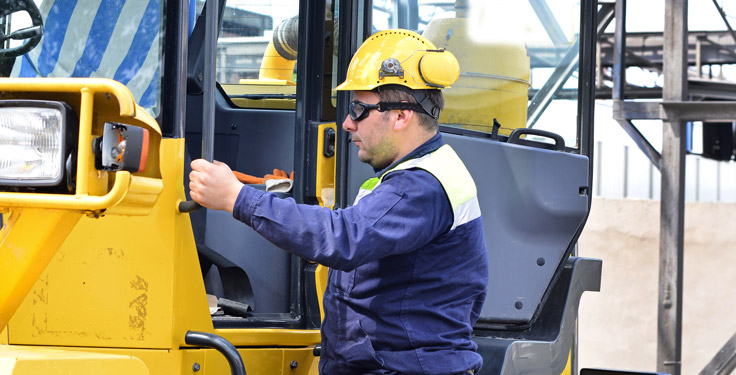
Common PPE includes hard hats, eye protection, high-visibility vests, steel-toed safety boots, gloves, hearing protection and task-appropriate respiratory protection.
Adhere to site-specific training
Knowledge is power. Training makes employees aware of hazards and supports a “safety culture” at the jobsite.
Ensure all applicable employees are certified and approved as required by the government regulations to be on the jobsite. In addition, all employees should complete any required site-specific safety courses prior to work beginning. (i.e., fall protection, confined spaces).
Respect mobile equipment right of way
Traffic flow creates a potential danger area for daily operators and jobsite visitors.
All traffic and directional signs must be in good working condition. Ensure all employees and visitors are trained on the proper traffic flow and abide by the rules set forth by the site.
For instance, some jobsites have a left-hand traffic pattern, which allows for better visibility of the ditch line and is safer in wet conditions. Right of way determines which vehicle moves first when two or more pieces of equipment are in the same area at the same time. Right of way should be pre-determined by site management and communicated to all individuals using haul roads.
Conduct walk-around inspections
Walk-around inspections only take a few minutes and are one of the best ways to prevent mechanical problems and avoid safety hazards. Details are provided in the manufacturer’s operation and maintenance manual, which should be kept in the cab of the machine.
Operators must understand the importance of completing the checks, and supervisors must allow time for a thorough evaluation. Look for equipment damage, leaks, cuts, cracks, rubbing, debris and excessive wear. Perform a walk-around every time you get off the machine and again at the end of a shift.
Avoid slips and falls
Poor footing conditions may cause slips and falls from equipment.
Use extreme caution when maneuvering on or near loose material. Organizing the work area is the best way to avoid slips and falls and make it clear that others are expected to do the same. For secure footing, slip-resistant shoes or boots should be worn.
Consider conditions that often lead to slips such as rain, mud, steep terrain, debris and use three points of contact when mounting and dismounting. Make sure the platform is free of tools, gloves and loose objects. Position your equipment when parking to safely dismount via manufacturer-designed mounting and dismounting points.
Maintain a safe travel distance between machines
Operators running equipment on the jobsite should maintain a safe traveling distance from other machines. Having additional space between machines is recommended to avoid accidents. Any number of variables can cause a person to brake, turn, stop or lose control of a vehicle.
Uphill and downhill slopes are also areas of concern. Ensure a safe travel distance is maintained at all times and employees are trained and aware of the site rules. Never follow a machine so close that it puts you outside their visibility zone.
Make training a commitment
Practice makes perfect. New operators should be properly trained before starting work on a jobsite. An operator who is not properly trained is a hazard to everyone on a site.
To create a safe work zone, it is important all employees understand the common communication practices used on the jobsite. Train employees on jobsite communication, such as:
• Keeping track of others in the work zone and letting them know where you are at all times.
• Establishing eye contact before entering a work zone.
• Creating two-way communication before entering a work zone.
• Informing co-workers when leaving a work zone.
Information from this article derived from Pit & Quarry University. Learn more at pitandquarry.com/pqu.