
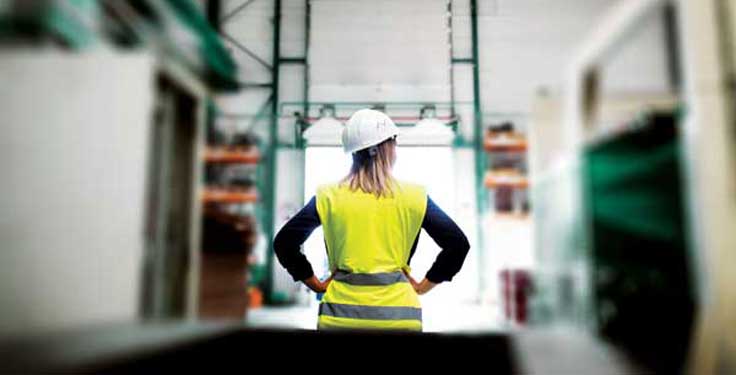


The construction industry is diversifying.
Sometimes viewed as “men only,” the workforce of the construction, mining and related industries is changing by the day. In fact, more than 1 million women work every day alongside men at construction companies big and small, and the industry has taken multiple steps to achieve equality across the workforce.
Women are still outnumbered in construction, though. According to the Bureau of Labor Statistics, about 1.1 million women work in construction, representing 9.9 percent of the industry’s workforce – meaning nearly one in 10 industry workers is a woman.
In the mining industry, women fill less than 20 percent of the leadership roles across global mining companies. According to S&P Global, women make up 18.1 percent of industry board positions, 14.9 percent of mining companies’ executive ranks and 13.2 percent of C-suite executive roles.
While the construction industry is clearly still a male majority, there have been conscious efforts within the industry to not only recognize its female workers, but also ensure they are getting equal treatment as their male counterparts.
For example, Women in Construction Week recognizes the women who have dedicated their careers to the industry. It is the first full week in March, aligning closely with International Women’s Day, which takes place March 8.
To commemorate this year’s Women in Construction Week, 31 female leaders from CRH gathered in Washington, D.C., to engage with Congress and share industry issues such as workforce development and infrastructure funding. CRH also set a goal to achieve 33 percent female senior leadership by 2030, which aligns with the Financial Times Stock Exchange 100 companies’ standard, illustrating one way the industry is committed to having women fairly represented.
In addition, the Bureau of Labor Statistics notes that the gender pay gap in the construction industry is significantly smaller – and nearly closed – with women earning 99.1 percent on average of what men make. This is well above the U.S. average of 81.1 percent.
As a minority in the industry, women sometimes face unique challenges, but – just like their male counterparts – they have proven themselves to be successful through dedication, perseverance and ambition.
Four women in the construction industry recently shared insights on their career paths, accomplishments and more with Portable Plants.
Stephenie Davis, Davis Industrial

In late 2007, Stephenie Davis, now president and CEO of Davis Industrial, was looking for a sales job. After landing an industrial sales gig with a conveyor service company in Tampa, Florida, Davis took the time to understand the ins and outs of conveyor belts.
“It’s not something you learn in school,” Davis says with a laugh.
Davis quickly fell in love with the industry and recognized its potential almost immediately. Two months from her start date, the company she worked for quietly went up for sale. In August 2008, Davis, a 21-year-old new to the industry, purchased the company, and BMG Conveyor Services was born.
Off the bat, Davis was faced with the recession of late 2008, and she had to quickly learn how to run a company in the midst of economic turmoil.
“The day I closed on the company, I kind of looked around and I’m like, ‘Okay, I’ve got three employees. We’re going to make this happen,’” Davis says. “And then the bottom fell out of the economy and I was like, ‘How am I going to do this?’ So we just hit the ground running and we diversified as much as we could possibly diversify.”

Davis’ bold moves were not without reward. Since her start, BMG Conveyor Services expanded from three employees to nearly 50, with hundreds of customers and product lines represented. It has also since been rebranded to Davis Industrial, and opened an additional location in Miami.
Davis Industrial received Tampa’s 2017 Small Business of the Year award and a Florida Companies to Watch award.
Davis says the industry has been very welcoming and encouraging to her, and she advises other women who are considering a career in the industry to strive for the best and always persist.
“If you’re willing to put in the work and struggle, try your best and push yourself to another level, everybody deserves a shot,” Davis says. “Part of our success is just never saying no, never giving up. We just don’t take no for an answer.”
Davis aspires to continue growing and diversifying Davis Industrial in the Southeast and across the U.S.
Mary Erholtz, Superior Industries

Mary Erholtz, vice president of marketing at Superior Industries, grew up in the aggregate industry. Her grandfather owned a sand and gravel and ready-mix operation, and her father founded Superior Industries. She worked at Superior throughout high school and college, and describes working in the industry as a “family legacy.”
When Erholtz began full-time at Superior 25 years ago, the company had about 65 employees, and there was no marketing team. She describes her early days as “wearing many hats” and prioritizing doing what she could to fill a need to help add value to the company.
Erholtz says one of her proudest moments was being named chair of the ConExpo/ConAgg 2020 management committee. She has also been involved with the Association of Equipment Manufacturers, as well as the National Stone, Sand & Gravel Association.
“I feel the desire and the need to continue to nurture and help with our strategies and our vision, and take Superior where we want to get to,” Erholtz says. “Right now, we’re working on our 2025 vision, and I find that exciting. It’s really challenging to be a part of because we have big goals and lofty dreams.”
Over the last 25 years, Erholtz says she has seen more women throughout the industry, and credits the industry for being welcoming and accepting of the diversity women bring to the workplace. She also encourages women to find other female mentors in the industry to lean on for guidance and support.
“For so many years, I was the only female in the room,” she says. “I don’t see that as negative, [but] when I go to [meetings] – whether it’s management meetings, my own company’s or association meetings – I really enjoy that there’s more and more women present, you’re not the only woman in the room and that they’re accepted in their roles.”
Karen Hubacz-Kiley, Bond Construction Corp.

Karen Hubacz-Kiley, COO at Massachusetts-based Bond Construction Corp., describes Bond as her “sandbox as a child.” The company was founded in 1964 by her grandfather, father and uncle, and is now on its fourth generation of family employees.
Working at the family company was a no-brainer for Hubacz-Kiley, who learned how to operate equipment at a young age. She likens her knowledge of the aggregate industry to children who grow up on farms. – it was second nature.
Although Hubacz-Kiley saw her career path in the industry as a natural progression, she says she received doubts from others. As a young girl, she would tell people she would one day work at the family company, but the sentiment was sometimes dismissed or even laughed at.
Still, Hubacz-Kiley was persistent. Her progression continued when, on her 18th birthday, she got her CDL license.
“I can probably run a dump truck better than I can my pickup,” Hubacz-Kiley says.
She began as a truck driver and moved up the ranks to weigh master, general manager and ultimately to her current position as COO.

The idea of women in construction is no longer seen as infeasible, as Hubacz-Kiley notes she has seen a lot more women enter the industry since she began.
“We’re looked at as equals now,” she says. “Granted, it’s harder for me to flip a loader tire than it is probably for a 6-ft., 4-[in.] guy, but women are doers. We’re phenomenal multitaskers and our minds are designed differently than men. Sometimes it’s a true asset to have women in key places in our industry.”
Hubacz-Kiley advises women who want to pursue a career in the construction or mining industries to simply go for it and grow from any obstacles along their path.
“Do your research and if you have a solid interest in it, go for it – why not?,” Hubacz-Kiley says. “It’s a phenomenal industry to be a part of [and is] full of great people. You’re going to have a couple that may give you resistance, but you’re going to find that in any industry. Take it in stride, learn from it, grow from it and it’s going to make you better in the end.”
Kristen Randall, Haver & Boecker Niagara

Kristen Randall, marketing manager at Haver & Boecker Niagara, began her career in various sales and marketing roles across several industries such as lumber, horticulture and sports before entering the mining and construction industry nearly 15 years ago.
In her role at Haver & Boecker Niagara, she is responsible for marketing in North America and Australia. She manages everything from advertising and public relations to trade shows and more.
When Randall began her career with the company in 2006, there was essentially no marketing department. Her first main task was to build up the marketing department in North America from square one, and then did the same for Austraia in 2013. In recent years, Randall has focused on developing the company’s international sales approach worldwide.
“That’s something I’m incredibly passionate about,” Randall says. “I worked with our team here to develop and brand our PROcheck sales approach, including how we approach customers and demonstrate value to them as their screening partner. That’s something I continue to work on today.”
Randall enjoys being able to both work in an office and travel for her job, meeting industry connections along the way. She says the community and relationships she’s formed in the industry have been especially important to her.
“I have learned so much about the industry and life in general from the partnerships and friendships made over the years,” Randall says. “Not just within Haver & Boecker Niagara, but with customers, members of the press and even other marketing professionals in our industry. Collaboration is really the key for anyone to build success.”
Despite being a woman in a male-dominated industry, Randall has felt entirely respected and equal by her peers and other industry members.
“Some might expect that in a male-dominated industry, you’re going to come across challenges because you’re female, and I have to say that the people I’ve had the pleasure of working with have really treated me with respect and professionalism,” she says. “I’ve always felt very included and welcome to the table in my position, and am thankful to work in an industry of great character.”