
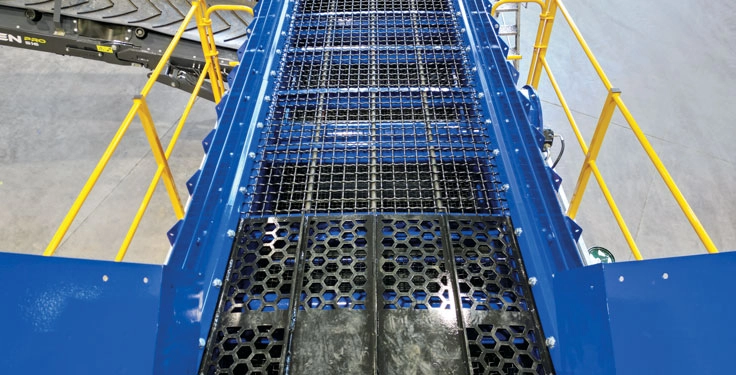

Screening technology has evolved dramatically over the last 20-plus years.
Modern screening plants are more productive, more efficient and easier to operate than ever before. Yet despite these advances, one challenge remains remarkably consistent.

Getting the most from a screening plant still depends on matching the right screen media to the right application. It sounds simple but, too often, operators focus on machine specification, horsepower or throughput while overlooking the screening surface itself. In reality, screen media has a direct impact on production rates, product quality, maintenance requirements and, ultimately, the profitability of an operation.
Historically, many operations simply replaced worn media with whatever came off the machine. Today, producers focus on lowest cost per ton rather than just the cheapest or longest-lasting panel.
Every material behaves differently
One thing experience teaches you very quickly is that no two material streams behave the same.
Hard limestone, recycled concrete, blasted granite and materials like topsoil, compost or reclaimed asphalt each present very different screening challenges.
Several factors affect how material stratifies across the deck and how effectively fines can pass through the apertures. Moisture content, particle shape, clay contamination, organic matter and oversize all need to be considered.
The best screening operations start by asking what the material is doing on the deck. Where it blinds or pegs, whether it travels too quickly and whether fines are carried into the oversize product.
Answering those questions usually tells you far more than simply looking at production figures.
Scalping screens in the spotlight
Across North America, heavy-duty scalping screens are now expected to process everything from virgin rock to demolition waste, reclaimed asphalt and topsoil.
Upper decks must withstand severe impact while lower decks deliver accurate products at high production rates. No single media type suits every job. Increasingly, operators combine different media across decks to maximize durability where impact is greatest and open area where throughput is the priority.
Throughput isn’t everything
One misconception is that longer wear life automatically means lower operating costs. That’s rarely the whole story.
Woven wire generally offers exceptional open area and excellent production rates. Polyurethane often delivers outstanding wear characteristics while helping reduce pegging in certain applications. Rubber excels in high-impact environments and can significantly reduce noise and vibration. Each has its strengths.
Sometimes, the media that wears out first delivers the lowest cost per ton by enabling higher throughput, while other applications benefit more from extended maintenance intervals. The right answer depends on the operation.
Increasing maintenance considerations
One challenge almost every producer talks about today is labor. Finding experienced maintenance personnel has become increasingly difficult, making downtime more expensive than ever before. That’s one reason modular screen media has become so popular.
Replacing individual panels rather than complete decks reduces maintenance time considerably while allowing operators to replace only the areas experiencing the greatest wear. It’s not necessarily about making maintenance easier. It’s about keeping machines producing material. Modular media reduces maintenance time and keeps machines producing saleable material.
Taking on trommel screens
Another area that has evolved of late is the growing use of trommel screens. While they’re long established in compost and topsoil production, we’re now seeing them increasingly used across biomass processing, waste recovery and recycling applications where traditional vibrating screens can struggle.
The tumbling action of a trommel often provides a more forgiving screening process, allowing material more opportunity to separate naturally while reducing blinding. As with vibrating screens, however, success still depends on understanding the material. Drum aperture size, hole configuration, rotational speed and retention time all influence final product quality.
There isn’t a universal setting, though. The best operators continually adapt their screening setup to match changing feedstock.
Looking ahead
More producers are embracing telematics and condition monitoring that provide real-time insight into vibration, stroke and operating condition. This helps maintenance teams move from reactive repairs to proactive interventions.
Additionally, producers are placing a greater emphasis on understanding the complete screening process, rather than simply investing in larger machines. They’re using production data and practical experience to refine screen media selection and machine settings as feed material changes.
The most productive screening plants rarely rely on a single breakthrough technology. Instead, they achieve consistent performance through a series of informed decisions that improve efficiency across the entire process.
Selecting the right screen media may not be the most visible part of an operation, but as material streams become more varied and operational pressures increase, thoughtful media selection will play an even greater role in improving product quality, reducing downtime and maximizing the value of every ton processed.
Lee Williamson is the North American distributor manager at Edge Innovate.
Related: Safer screen media changeouts