
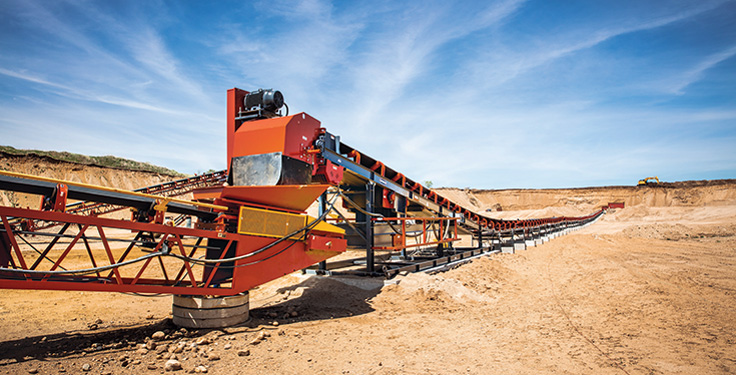


Portable conveying and material handling equipment offers a sense of ease and flexibility to producers and contractors.
Throughout the years, new technologies have been introduced to the portable market that are designed to increase efficiency and reduce downtime. More recently, the pandemic and the related economic downturn served as a driving force to reduce costs and implement tech such as automation.
The latest trends
For example, Stephenie Davis, president and CEO of Davis Industrial, a dealer offering conveying and material handling equipment, sees a shift toward customer-centric equipment.
“Previously, we had seen where manufacturers will produce a product and customers take it or leave it,” Davis says. “Now, they’re really working hand in hand with the end users to develop solutions to the problems rather than just pushing a product out to market.”
Travis Thooft, chief engineer of portable conveyors at Superior Industries, agrees there’s an increase in customizing equipment. Thooft sees an uptick in producers opting for portable conveyors as an alternative to stationary systems, with the trend being accelerated by the pandemic’s economic downturn.
“I think some producers are looking at bigger projects and looking for ways to keep those projects going without having to have the same overhead capital cost of a larger stationary system,” Thooft says. “If something didn’t work out, a portable conveyor offers an alternative to get some better resale value if there’s something that doesn’t happen with a given plant longer term.”
The economy is also top of mind for Matt Lepp, heavy industry drive specialist at VDG (Van der Graaf), which specializes in drum motors for conveying. Lepp cites a recent change in producer purchasing strategies.
“Producers are looking a lot more toward the long-term savings: the $100 fix that lasts six months versus a little bit more of an expensive fix that will last a lot longer and actually save you money over time,” Lepp says. “I think purchasing decisions are becoming a lot more intelligent.”
Adapting to producers’ changing needs
As a dealer, Davis sees an increased need to be present for customers when it comes to new equipment, especially when producers may not be able to meet customers on-site as frequently due to the pandemic.
“You can’t really adapt these technologies in real-time based on a computer screen,” she says. “You’ve got to actually be there and see the application and have those conversations and see the product running. I think a lot of the manufacturers are relying on people like us to get out there and be the boots on the ground to help adapt this technology.”
Despite a decrease in on-site training, Davis says the manufacturers her company represents continue to bring new technology to the industry and offer resources to customers.
“They’re doing a great job in the foreground and the background to bring this to the market, have the right solutions out there and really just have product support behind it – whether it be webinars or online virtual meetings – to be able to bring this technology out there,” Davis says.
On the manufacturing side, Superior responded to customer needs by offering equipment designed to fit a number of applications while featuring a combination of manual and gravity take-up to allow for more flexibility and overall length.
“It’s a new approach to a traditional problem,” Thooft says. “Most traditional conveyors either use a screw take-up or a manual pickup, [and] up to about 200 ft. is where it loses its ability to function well. Whereas if you pair that with a gravity takeup, it allows it to take up the more dynamic belt stretch on the conveyor, and then you can still use your manual takeup at a lower cost point to make sure your permanent stretch is taken care of.”
Meanwhile, VDG’s metal bar-reinforced sectional lagging systems have proven to be popular among customers and continue to drive demand throughout the last few years, according to Lepp.
“We’ve basically reinvented pulley lagging to an extent that we now see significant increases in light [and] significant increases in pulling force, which both lead to a reduction on bearing forces and an increase in system light – which means less maintenance, less downtime for the user,” Lepp says.
VDG also introduced condition monitoring, where it can provide feedback on a number of critical performance factors such as temperature and vibration. The technology is designed to give producers a real-time snapshot on the quality and condition of their drives in order to minimize costs and make more informed operational decisions.
Looking ahead
While Thooft admits it is hard to predict the future, he believes the trend of automation and a focus on safety and ease will continue in portable conveying equipment.
“With (the Mine Safety & Health Administration) continuing to come out with more robust rules for the operator, I think many producers are going to be looking at ways that they can meet MSHA [requirements], as well as make it easier for their guys on-site to operate the equipment they have,” Thooft says.
Davis agrees with the sentiment that portable conveying equipment will continue to see more advancements in technology as time unfolds, especially as producers demands change – be it a need for automation, flexibility or minimized costs.
“There’s a different set of challenges when it comes to portable equipment and the stuff that moves around from day to day,” Davis says. “So I think we’re going to see a lot more technology out there, and that’s what’s really going to help push the portable industry and keep the reliability and productivity up and keep the downtime down.”