
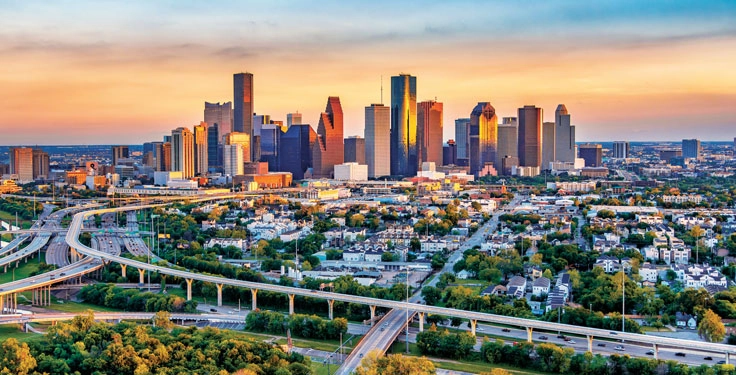

As the saying goes: Everything’s bigger in Texas.
Over the last several years, this saying has been especially true when it comes to the business being done in the Lone Star State. According to CNBC’s America’s Top States for Business 2026 study, Texas’s economy ranked second in the nation and the state ranked fourth overall for doing business.
The study notes that Texas recorded a $2.27 trillion GDP in 2025, up 2.5 percent, and leads the nation in exports per capita. A large part of what is buoying the state is the companies that are headquartered there. Oracle shifted its headquarters from Silicon Valley to Austin in 2020, Tesla opened its Austin-based Gigafactory in 2022 and earlier this year, NVIDIA broke ground on a manufacturing facility in Sherman.
It isn’t just the business environment that is booming in Texas. The state’s population is growing at a torrid pace as well.
Across 2024 and 2025, Texas added the most residents of any state with more than 391,000, bringing its total to 31.7 million, according to the U.S. Census Bureau. Additionally, Harris County – home to Houston and the third-most populous county in the U.S. – is the fastest-growing county by population, adding 48,695 residents from 2024 to 2025.
“‘The Texas Miracle’ is alive and well with the population growth we’re seeing,” says Andrew Pinkerton, president and CEO of the Texas Aggregates & Concrete Association. “Most of our metropolitan statistical areas rank very highly in several metrics from construction employment to GDP. We’re No. 1 in aggregate production and sales, No. 1 in ready-mix production and No. 1 in cement consumption. It’s all flowing behind that population growth.”
With an increased need for facilities comes an increased need for construction materials. Producers, contractors, manufacturers and dealers alike have felt this demand.
“It continues to be the same in Texas – very strong,” says Matt Arnold, vice president of operations at Knife River Corp. “We have a lot of strong markets. This is where people want to invest. A lot of corporations are moving their offices to Texas. They’re coming here because this is a great place for people to invest in and it continues to be that way. Texas is a big part of our business, and we plan to continue to grow along with the state.”
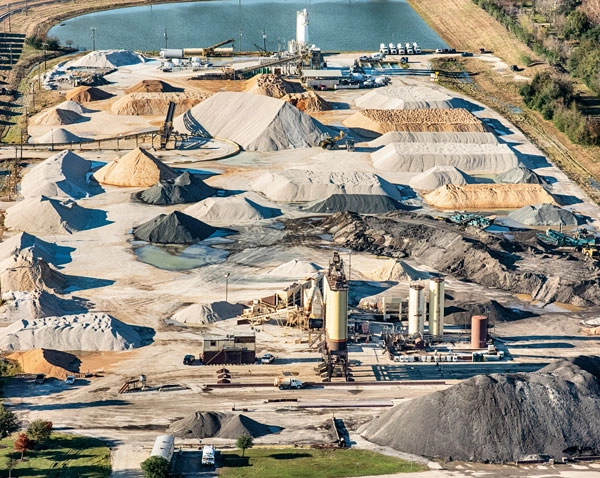
According to the U.S. Geological Survey, Texas was the No. 1-producing state for both crushed stone (192 million tons) and sand and gravel (100 million tons) in 2025, generating $5.23 billion in value. That trend continued through the first quarter of 2026, with Texas once again registering as the top state for each subset, producing 47.1 million tons of crushed stone and 25.1 million tons of sand and gravel.
Driven by data
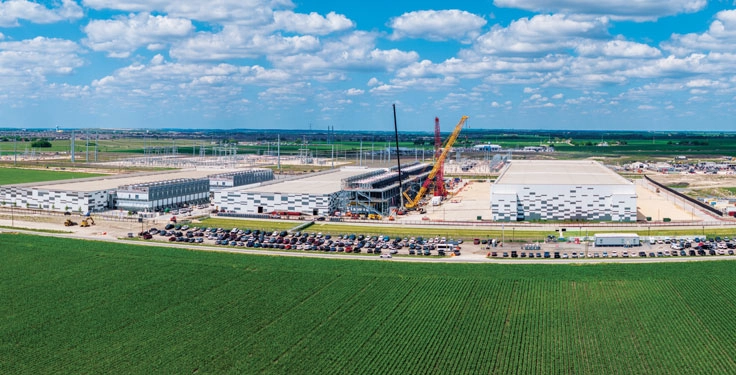
While there have been plenty of trends and project types that have kept Texas growing in recent years, one stands out among the rest: data centers.
“In Texas, [the counties] are saying there are 471 data centers presently built or in production in the state,” says John Crisp, CEO of Crisp Industries. “About 12 to 13 miles west of Bridgeport, Google is building a very large data center. It will have two or three of its own in-house power plants. It’s going to create a lot of work, especially in the aggregate business for truckers and quarries.”
In another data center project, Crisp notes that Edged Energy, a global technology infrastructure company, recently purchased a 186-acre site within the 5,500-acre Veale Ranch in Fort Worth, Texas, to build a data center campus.
“There are pockets around where these data centers are popping up that our customers are swamped trying to get materials to them,” says Duane Winter, president at Crisp. “The whole town of Abilene has exploded. I feel like it’s probably a short-term explosion, but it’s like the Wild West right now.”
As one industry economist puts it, both in Texas and nationwide, there is no sign of AI-driven investment slowing. This is due, in part, to the fact that the push for more data centers is being driven by “hyperscaler” companies such as Amazon, Alphabet, Meta and Microsoft.
“In the aggregate, those companies spent around $400 to $450 billion on artificial intelligence infrastructure and architecture last year,” says Anirban Basu, CEO of Sage Policy Group and chief economist for the Associated Builders & Contractors. “The estimate for this year is between $700 and $725 billion. That could add more than a full percentage point to gross domestic product. We are very much in the midst of an AI-spending super cycle, and it’s not going to slow down anytime in the near term.”
Looking ahead
With plenty to keep them busy, Pinkerton, Arnold, Crisp and Winter are all optimistic about what the rest of this year – and beyond – has in store for their businesses and the state.
“Expectations are high,” Pinkerton says. “We haven’t seen the slowdown in population growth, and we continue to see elevated numbers from the Texas Department of Transportation. There are so many different metrics that point to a very positive year and future altogether.”
Adds Arnold: “We’re seeing the same thing on the Knife River front. We had some struggles at the start of the year with weather, but that just pent up demand for later. I think we’re going to have a strong year.”
Crisp, for one, is excited to continue growing alongside his company’s customers.
“We try to take care of them, and they all do a very good job of taking care of us,” he says. “I’ve been in this business for 50 years, and aggregate producers are always continuing to grow and have new ideas. That’s what keeps us all busy and keeps us going.
“Our hope is the same hope it’s always been,” he adds. “That there continue to be people out there living the American dream and pushing to do bigger and better things.”
Related: An economist’s midyear outlook of the construction economy